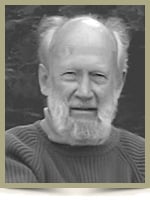
Born in Sandycove, County Dublin, Ireland June 7, 1920. Died in Victoria, BC July 17, 2009.
George is probably best remembered as a teacher and artist. Educated at St. Columba’s College, he went on to read philosophy at Trinity College, Dublin (1939-44). On leaving Ireland, he held temporary teaching posts at Radley and Eastbourne Colleges, married Margaret and continued his studies at the West of England College of Art, Bristol. For the next eight years, with a growing family, he taught at the Falmouth School of Art, Cornwall. In 1957 the family emigrated to Canada, where he taught at Ryerson, Toronto and Blakelock High School, Oakville, before moving to McMaster University, Hamilton. There, he was instrumental in developing the Fine Arts Department and in creating an art collection which now includes the Herman Levy bequest. His large, public, welded steel sculptures from that time reflect “The Steel City” and may be seen at McMaster University, Mohawk College, the Art Gallery of Hamilton, the Jewish Community Centre, the MacDonald Stewart Art Centre in Guelph; as well as in London at the Church of St. John the Divine and at the Halton County Court House. When George retired to Victoria in 1985, he explored one media after another: drawing, etching, painting, sculpting and making monotypes. He researched historical techniques and, an acknowledged expert in the history of printmaking and paper, he spent hours cataloguing the print collection at the Art Gallery of Greater Victoria. He has had 13 solo exhibitions in major galleries, including both the Art Galleries of Hamilton and Greater Victoria. In 2007, although suffering from Alzheimer’s, he continued to draw in St. Charles Manor Care Home. These last works will be on display at a celebration in remembrance of his life at the Art Gallery of Greater Victoria on Sunday, August 9, from 2-4 pm.
George is mourned by his wife, Margaret, Kit (Patsy), Julia (Randy), Mark; and five grandchildren.


20 Responses
Cleaning my bookshelves, I found a catalogue of George Wallace’s Hamilton area welded sculptures. He was my ‘mentor’ at McMaster in the late ’70s and was absolutely pivotal in my career choice, having placed me as an apprentice potter with his friend Helen Brink.
So I checked the web, and found that he had died almost a year ago.
My belated condolences to his family, coupled with profound gratitude for his influence on my life.
Carolynne.
Dear Margaret and Family:
Please accept my sincere condolence on your loss. I read of George’s passing in the latest issue of the McMaster University Retirees Association newsletter. My memories of George are of chatting with him in his studio on the grounds of your lovely home on Governor’s Road in Dundas; as noted by Peter Elliot, his welding goggles were resting on his forehead! I always loved your beautiful and artistic gardens, and enjoyed visiting with you both.
This note is being sent from Lunenburg, Nova Scotia, where we moved with my Mom in the spring of 2007. The coast, as you found, is a lovely place in which to retire!
With great regard,
Doreen
To the Family of George Wallace
In a book which I found on the bookshelf on the top Floor
of Huntington Street is an excerpt from Reinhold Niebhr
and the book is How the Irish Saved Civilization by Thomas Cahill
this piece spoke to me and I had a discussion about it
with Geo. It reminds me of how his views and art shed light on the
small details that fell out of the big picture of our civilization.
NOTHING THAT IS WORTH DOING CAN BE ACHIEVED IN OUR
LIFETIME ; THEREFORE WE MUST BE SAVED BY HOPE.
NOTHING WHICH IS TRUE OR BEAUTIFUL OR GOOD MAKES
COMPLETE SENSE IN ANY IMMEDIATE CONTEXT OF HISTORY;
THEREFORE WE MUST BE SAVED BY FAITH.
NOTHING WE DO, HOWEVER VIRTUOUS, CAN BE ACCOMPLISHED ALONE; THEREFORE WE MUST BE SAVED BY LOVE
IT was an honour and delight to have him as a friend.
Geo was an inspiring noble man
Herta Buller
Melissa, Sam and I were saddened to hear of George’s passing. The time we had the pleasure of being part of the family and getting to know him has a special place in our memories. I see him in my mind’s eye with the twinkle in his eye, and especially remember his wit and warmth.
We wish you every comfort the memories of the fine times with him bring,
with love from Sue, Melissa and Sam
I am so sorry to have learned so late that we have lost George. I am deeply sorry, also, that I didn’t see him these last years. We have had our health problems recently. I am sorry that I did not follow Margaret when she moved – and I do not have her address or telephone number (unless it is the same as the old one – I’ll try it).
I am also very distressed that I will miss the event on Sunday. I have to be in Vancouver to attend a quartet concert in which Frances is playing. I will be in touch with Margaret jusy as soon as I can on our return.
George was an exceptional person – but you all know that. Those of us who had the good fortune to be involved with him loved him dearly. He communicated a warmth and breadth of spirit that was totally his own. His sense of humour and wit – his remarkable way of seeing things in a different way and communicating them, made him a fascinating companion.
Artistically he was immensely gifted. When you looked at his figures or his sculptures, or his prints – he was mostly interested in the human figure or face – the world became a different place. His angels soared, his crabby gentlemen leered. His funny hats mocked. Relationships invited questions. One never knew where he would take you next. But there was a depth and sensitivity in his drawings that was particularly fine.
I would like to go on and on about this – his work begged you to explore it. For now, I just want to extend my sympathy to Margaret and the family. I will be in touch next week, as soon as I can find your telephone number and address – Peter joins me in love to you all – Erica.
I am so sorry to have learned so late that we have lost George. I am deeply sorry, also, that I didn’t see him these last years. We have had our health problems recently. I am sorry that I did not follow Margaret when she moved – and I do not have her address or telephone number (unless it is the same as the old one – I’ll try it).
I am also very distressed that I will miss the event on Sunday. I have to be in Vancouver to attend a quartet concert in which Frances is playing. I will be in touch with Margaret jusy as soon as I can on our return.
George was an exceptional person – but you all know that. Those of us who had the good fortune to be involved with him loved him dearly. He communicated a warmth and breadth of spirit that was totally his own. His sense of humour and wit – his remarkable way of seeing things in a different way and communicating them, made him a fascinating companion.
Artistically he was immensely gifted. When you looked at his figures or his sculptures, or his prints – he was mostly interested in the human figure or face – the world became a different place. His angels soared, his crabby gentlemen leered. His funny hats mocked. Relationships invited questions. One never knew where he would take you next. But there was a depth and sensitivity in his drawings that was particularly fine.
I would like to go on and on about this – his work begged you to explore it. For now, I just want to extend my sympathy to Margaret and the family. I will be in touch next week, as soon as I can find your telephone number and address – Peter joins me in love to you all – Erica.
Immensely gifted artistically
I am grieved to learn of your loss and assure you of my deepest sympathy. Geo was a fine artist and a man of steady integrity. I really feel that this country is the less for losing him. But we do have his work which will continue to nourish us. I also remember his stories of Radley and other subjects. I am with you in your trouble. Love
Kildare
Dear Margaret and family,
Please accept my sympathy on your loss. George was certainly a person who made a difference in a most constructive way, and he will be greatly missed.
Warmest regards,
Peter
Peter Redpath
Dear Mrs. Wallace and family,
My deep and respectful condolences go out to all of you. There is also a sizeable group of fellow visual artists and appreciators of profound sculpture, prints, monotypes, and drawings who keenly grieve George’s death and joyfully celebrate his life. His former students, who carry his influence in their work and in their dedication to their work for the rest of their lives, feel a special indebtedness to George.
I came to know George during my tenure (1981-85) as Administrator of the Hamilton Artists Inc. The Inc. is an artist-run organization and gallery founded in 1975 and maintained to this day to a great extent by his former students.
From March 30 to April 30, 1983, a retrospective exhibition of ten large sculptures and twenty-seven graphic works by George Wallace was held at Hamilton Artists Inc. This exhibition was also the occasion of the first publication by the Inc., an illustrated catalogue with an introductory essay by Robert Yates. It was during the planning and the exhibition of 1983 that I came to know George.
I remember the thrill of encountering George during that time. (I had not studied with him.) He was initially somewhat intimidating to a young, aspiring artist. He was so knowledgeable; in all our eyes indisputably a great artist; difficult to read personally: sometimes seemingly gruff, but with a twinkle in his eye and a dry, ironic humour; so well-spoken in a way that seemed unattainable to a Canadian-born youth. Yet, he also seemed so appreciative, even honoured, to have an exhibition at the Inc.; so respectful of our efforts to establish a gallery on the street in the north end of Hamilton. We felt he took us seriously, and that meant a great deal to all of us. George had decided to apply paint, in flesh tones, to the figure in his just-completed welded steel sculpture, Lazarus risen from the dead. He shared with us his wonderings about that decision; encouraged our reflections. His apparent indecision about using flesh tones, his quest to fulfill the meaning of the piece, perhaps a feeling within himself that he’d gone ‘too far’ were for me a lesson never forgotten in the humility , even the insecurity, of the artist, even one who was so accomplished. And he took such joy in startling the viewer into genuinely engaging with the work, rousing the viewer to wake up.
Much before meeting George, I had known and been moved, shocked, by his work. It was probably in the summer of 1962, on a night of driving rain, thunder and lightening, that I took shelter on the back veranda of Wentworth House, the student centre at McMaster. I was a high school student. In a flash of lightening, I saw a figure hanging from the rafters. I truly thought that I’d encountered a suicide. It was George’s The Hanging Thief. It was also about 1962 that my parents bought a monotype of George’s called Night Sky (1960). It now hangs in my living room and I’ve looked at that work with awe almost every day for forty-five years. For me, it is the quintessential image of the depth and vitality of the universe.
George contributed so much to the life and work of all the artists who knew him and are familiar with his work. He continues to inspire us.
Respectfully,
Sam Robinson
Dear Margaret and family,
Peggy and I were so sorry to learn of George’s death. We treasure our many pleasant memories of knowing both of you during your years in Hamilton. Although we haven’t had much contact with you since your move to Victoria, we have heard news of you from time to time, most recently when we met John Miecznikowski, the sculptor and expert foundryman who was entrusted by George with the exacting task of casting the spectacular series of bronze Heads he had created. We will never forget how awed we were by these splendid works when they were exhibited at the Art Gallery of Hamilton in 2001. We hope that they will be kept together in the way George intended and that someone, somewhere, somehow, will ensure that they are assembled in a gallery for future art lovers to admire.
My favorite memory of George was the rare opportunity to propose his engagement to create the two wonderful welded steel sculptures for the new Mohawk College which he installed there in 1969. I not only had the privilege of listening to George expound the philosophy which underlaid his remarkable works, but I was welcomed into his studio in the barn behind your lovely old house in Dundas to observe the works growing under his welding torch.
Anthony Butler